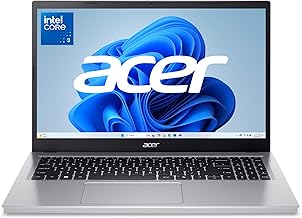

Acer Aspire Go 15.6″ Core 3
Today
Typical price$353
Amazon: the cheapest today among the stores checked
4.3 out of 10 on the spec sheet
Buy on Amazon Laptop Radar
Updated Nov 6, 2026
Aspire Go 15.6″ Core 3 costs $247 less today; Vivobook 17.3″ Core 3 100U has score 0.3 higher (4.6 vs. 4.3).
4.3score
4.6score · higher
Acer wins 2by componentAsus wins 1
Acer Aspire Go 15.6″ Core 3 is $247 the cheaperAsus Vivobook 17.3″ Core 3 100U is the cheaper
Aspire Go 15.6″ Core 3 wins on screen and ports and how current it is; Vivobook 17.3″ Core 3 100U wins on memory and storage.
Amazon: the cheapest today among the stores checked
4.3 out of 10 on the spec sheet
Buy on AmazonAmazon: the cheapest today among the stores checked
4.6 out of 10 on the spec sheet +0.3
Buy on AmazonAffiliate links: if you buy, the store pays us a commission at no cost to you.
First data point for one of the two: the chart appears as the days go by.
Still only a few days of data for both to read the trend; the chart fills in as the days go by.
Updated 06/11/2026
| Item | Aspire Go 15.6″ Core 3 | Vivobook 17.3″ Core 3 100U |
|---|---|---|
| Performance | ||
| Processor | Core 3 | Core 3 |
| Processor model changes | not listed | 100U |
| RAM | 8 GB | 8 GB |
| Storage changes | 128 GB | 512 GB |
| Storage type changes | UFS | SSD |
| Screen | ||
| Size changes | 15.6 polegadas | 17.3 polegadas |
| Resolution | Full HD | Full HD |
| Screen type changes | IPS | not listed |
| Connections | ||
| Wi-Fi generation changes | Wi-Fi 6 | not listed |
| General | ||
| System | Windows | Windows |
| Model code changes | N355 | F1704VA |
 Aspire Go 15.6″ Core 3 orAcer Aspire 3 14″ Core i3-N305$470 · score 4.6Comparar
 Aspire Go 15.6″ Core 3 orAcer Aspire 3 15.6″ Ryzen 3 7320U$370 · score 4.1Comparar
 Aspire Go 15.6″ Core 3 orAcer Aspire Go 15.6″ Core i3-N305$395 · score 4.6Comparar
 Aspire Go 15.6″ Core 3 orAcer Aspire Go 15.6″ Ryzen 3$410 · score 4.6Comparar
 Aspire Go 15.6″ Core 3 orAsus Vivobook 14″ Core i3-1215U$485 · score 4.1Comparar
 Aspire Go 15.6″ Core 3 orAsus Vivobook 15.6″ Core 3 100U$476 · score 4.3Comparar
Source: Amazon.com catalog, checked on 06/11/2026.
Lowest price seen for the product on Amazon.com, shipped to New York 10001, on the day it was read, before sales tax. The model is the brand plus the name of the laptop; the versions go in the table. The price range, the median and the position use only models with a score; the price comparison looks at models whose score is within 0.5 points.
The spec score doesn’t measure real-world performance or durability, and the strong or weak point reading is just a comparison of numbers, not a buying recommendation.